Westende on the island of Testerep (1087 to 1885)
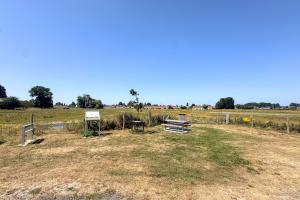
For centuries Westende was a small polder village at the western tip of an island.
- The island of Testerep: in the Middle Ages Westende lay at the western tip of Testerep, a medieval island along the coast that reached as far as Ostend.
- First mention (1087): Westende was mentioned as early as 1087 and became a separate parish in 1196.
- Westhende (1777): on the Ferraris maps of 1777 the village is called Westhende, with a windmill and a few scattered farms.
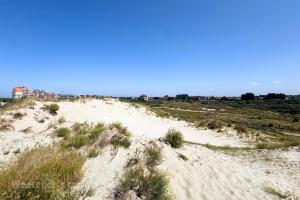
- Empty dunes: until the 19th century the dunes and the beach north of the village were almost uninhabited.
- The first tram (1885): in 1885 the very first NMVB tram line ran from Ostend to Westende-Dorp and beyond; this steam tram kept running until 1955.

Édouard Otlet and the seaside resort (1888 to 1914)
At the end of the 19th century a Brussels industrialist built a complete seaside resort in the dunes at his own expense.
- 64 hectares of dunes (1888): in 1888 the Brussels industrialist Édouard Otlet bought 64 hectares of dunes, and in 1897 he had a sea wall built.
- All private capital: Westende-Bad got tennis courts, a church, a post office, a kursaal and its own power station.
- The electric tram (1903): in 1903 the electric tram from Ostend to Middelkerke was extended to Westende-Bad; it grew into today's coastal tram, which still has a turning loop here.
- Grand Hôtel Bellevue (1911): architect Octave Van Rysselberghe designed the hotel with its round front section, locally known as the Rotonde; it opened in June 1911 with 120 rooms, two lifts and sixteen baths with warm seawater.
- Royal guests: members of the royal family also holidayed at the Grand Hôtel Bellevue.
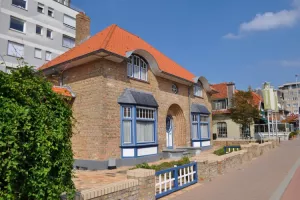
- Exclusive resort: on the eve of the First World War Westende had two grand hotels and hundreds of villas in all kinds of styles.

War and reconstruction (1914 to 1945)
Two world wars left deep marks on the young resort.
- Destroyed (1914 to 1918): close to the front on the Yser, Westende was almost completely destroyed by shelling in the First World War; the Grand Hôtel Bellevue was one of the few buildings left standing.
- Reconstruction (1920s and 1930s): Westende was rebuilt in the 1920s and 1930s; the Westend Hôtel rose again in 1924 as the Westend Palace.
- Sint-Laurentiuskerk (1922): the neo-Gothic Sint-Laurentiuskerk in Westende-Dorp was rebuilt in 1922; the Sint-Theresiakapel in Westende-Bad dates from 1930.
- Kleine Bamburg (1920): the listed farm Kleine Bamburg was rebuilt in 1920.
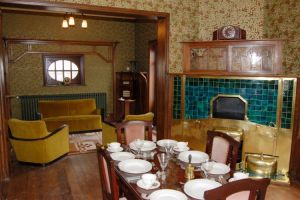
- Refugees: during the Second World War refugees lived in Villa Les Zéphyrs, and much of the original furnishings disappeared.
Mass tourism and nature restoration (1945 to today)
After the war the villas made way for apartments, and nature slowly regained its space.
- Apartment blocks (1960s): mass tourism brought apartment blocks from the 1960s onwards; almost all the villas disappeared.
- Westend Palace (1972): after years of decay the Westend Palace was demolished in 1972.
- Grand Hôtel Bellevue: after the Second World War most of the hotel was converted into apartments; the facades have been listed since 1984, and in 2009 the hotel was the setting for the TV programme Het Hotel Westende.
- Tourist office (1972): in 1972 the municipality of Westende rented Villa Les Zéphyrs as its tourist office, which saved the interior.
- Mergers (1971 and 1977): in 1971 Lombardsijde merged with Westende, and in 1977 both became part of Middelkerke.