
 Buy tickets in advance now
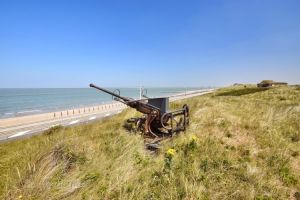

Hidden gems in Westende
Westende holds more Belle Époque heritage and art than you would expect behind its promenade.
- The Rotunda: on the eastern edge of Westende, right on the promenade, stands the Grand Hôtel Bellevue, locally known as the Rotonde after its rounded front. Architect Octave Van Rysselberghe built it between 1909 and 1911 as a luxury hotel, with a reinforced concrete frame clad in natural stone. It is one of the few buildings here that survived the First World War; today it holds apartments, so you admire the listed facades from outside.
- Listening to the sea: at the eastern end of the promenade, close to the Rotonde, two thirteen metre metal horns point at the waves. The artwork I can hear it by Latvian artist Ivars Drulle dates from 2012 and looks like a giant gramophone: a woman listens at one horn and leaves the other free for anyone who wants to join in.
- The old village: a kilometre inland, in Westende-Dorp, the Sint-Laurentiuskerk stands on the Westendelaan. The village and its church were almost entirely lost in the First World War, and the present neo-Gothic hall church in yellow brick was built in 1922. A war memorial stands in front, and to the west two grave monuments recall the former churchyard.
- A chapel among the villas: on the Henri Jasparlaan in Westende-Bad stands the Sint-Theresiakapel from 1930, designed by Victor Rubbers for the growing number of summer visitors. A round stair turret doubles as the bell tower, and inside the 1960s stained glass windows by Cor Westerduin colour the light.
Practical tips
These tips help you get even more out of your visit to Westende.
- Tides: plan a beach walk or a bike ride along the coast with the tide table.
- The weather: the weather page shows the forecast and hours of sunshine for the coming days.
- By bike: most sights are easy to reach by bike.
» View our complete 'see & do' list with many more museums, attractions, monuments and other places of interest.